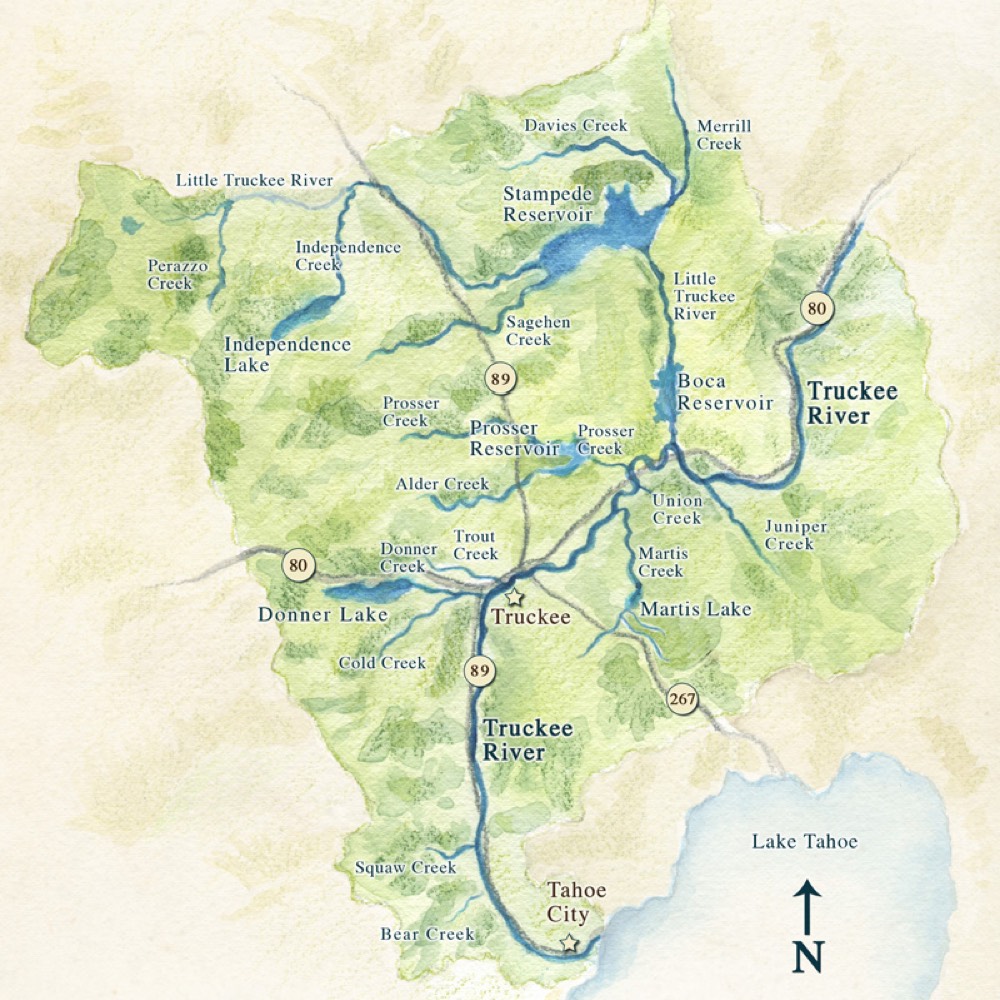
Our area of focus is the Middle Truckee River watershed. The middle watershed is the 35-mile stretch of river that runs northeast from Tahoe City to the California/Nevada state line, and all the tributaries that feed into this stretch of the river.
The Upper Truckee flows into the southern end of Lake Tahoe. The Middle Truckee flows out of Lake Tahoe and to the CA/NV state line. The Lower Truckee flows from the state line to Pyramid Lake.
The Middle Truckee River watershed - the area draining into the Middle Truckee River - covers approximately 435 square miles, or 285,000 acres of land.
The Truckee River watershed has six major reservoirs: Independence Lake, Donner Lake, Martis Lake and Stampede, Prosser and Boca reservoirs.
The State of California and the US Environmental Protection Agency have identified the Truckee River and its tributaries as impaired (polluted) for sediment. Squaw Creek is also identified by these agencies as impaired for sediment. Donner Lake is impaired for PCB’s. Streams in the Truckee River watershed appear to contain few contaminants and nutrients. The TRWC restoration and protection projects are targeted at restoring the causes and effects of impairment.
Photo: Russ Rosewood photo-sensitiveCalifornia Flyfisher magazine, a signatory of the Truckee River Watershed Council, has done a great job organizing flow information on their web site.
Because meadow and riparian zones link land with water, they are important for most wildlife and they support larger densities and varieties of species than other habitats. They are also used for recreation, grazing, water quality protection and water supply development.
The watershed receives on average 30-40" of precipitation per year. However, actual amounts can differ substantially within the watershed. For example, Webber Lake receives as much as 85" a year, while Upper Dog Creek can get 14".
Elevation ranges from 5,050' at the California-Nevada state line to 10,778' at the top of Mount Rose. The Truckee River starts at about 6,200' at the Lake Tahoe outlet and is at 5,000' at state line.
A significant portion of the watershed is located above 6,000 feet, with steep tributary streams flowing through narrow, steep-walled canyons and other tributaries entering through wider, flatter glaciated channels.
Soils above 6,500' are formed from weathered volcanic, metasedimentary and granitic rock and include glacial and alluvial deposits. Soils at 4,800-6,500' are formed primarily from weathered volcanic, rhyolitic and granitic rock and alluvial deposits.
Native species include: mountain whitefish, Paiute sculpin, Lahontan redside sucker, Tahoe sucker, and mountain sucker, as well as the listed Cui-ui and Lahontan Cutthroat Trout. Non-native fish include rainbow, brown trout and brook trout.
The watershed hosts a number of special status species including the Lahontan cutthroat trout; California spotted owl, Northern goshawk and Willow flycatcher; Mountain yellow-legged frog; and plants including Dog Valley ivesia.
Vegetation cover includes mixed conifer forest, Great Basin sage scrub, and alpine meadows of grasses and wildflowers. Peaks are generally barren. Riparian vegetation of cottonwood, aspen, dogwood, willow, sedges and grasses grow along the river edges.
Higher elevations and cooler temperatures in the Middle Truckee watershed lead to a growing season of 50 to 100 days in the higher elevations to 115 or more days in the lower elevations.
Explore this web site! Take a look at the projects pages, Weed Warriors pages, River Friendly Landscaping pages, and Adopt-a-Stream. For specific questions please contact us.
Home | About | Events & Programs | Projects | Weed Warriors | River Friendly Landscaping | Get Involved | Donate | News
truckeeriverwc.org • info@truckeeriverwc.org • 530-550-8760
PO Box 8568, Truckee, CA 96162 • 10418 Donner Pass Rd # B, Truckee, CA 96161
Copyright © Truckee River Watershed Council • Sitemap • Admin • Site Design by Sara Zimmerman Art, Illustration, and Design